Part II ended with a sound tenant and lenders holding its options. To see why those lenders were willing, follow the money round, and the same few names keep appearing on both sides of the ledger.
The Loop
Anthropic's own risk factors say it plainly. Amazon, Google and Microsoft, through their affiliates, have made significant equity investments in the company, and they are at once its investors, its customers, its suppliers of compute, its landlords and its competitors.1 Put every counterparty on one page and the pattern is hard to miss.
Source: Anthropic, PBC, Form S-1, 26 Oct 2026; Microsoft and Nvidia announcement, Nov 2025.1,2
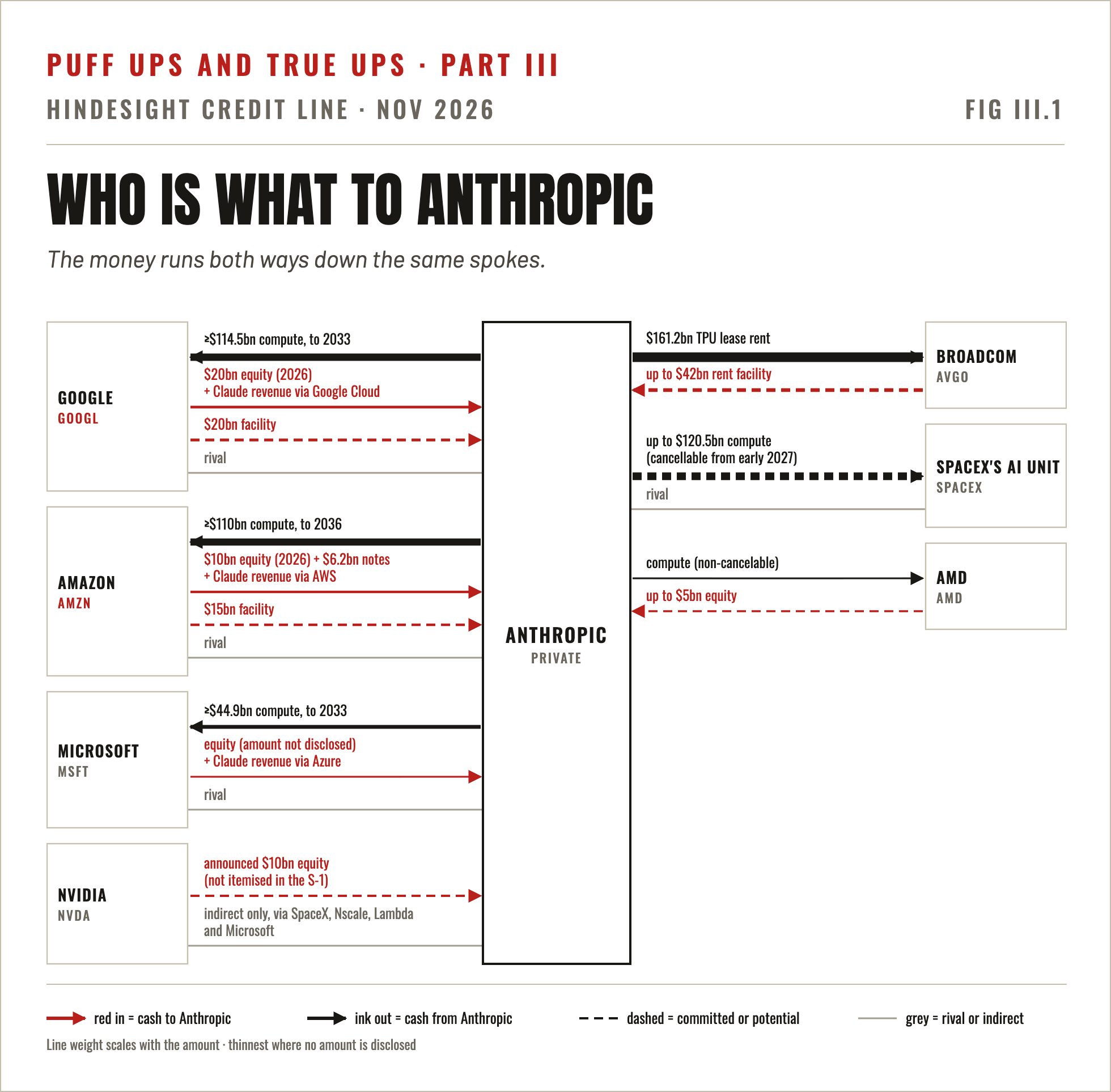
HS Chart NoteAmazon and Google send Anthropic money and take it back down the same spoke: they invest in it, lend to it, sell its models, rent it their clouds and compete with it. The investors are the suppliers, and their returns on one depend on the other.
Open full size →Now follow a dollar round. Google put $20bn of new equity into Anthropic this year, and Amazon $10bn.1 Anthropic committed at least $225bn of minimum spending to their clouds, which becomes their backlog; if those minimums sit inside the backlogs the clouds reported at the end of June, Anthropic alone accounts for about 22% of Google Cloud's $514bn and of Amazon Web Services' $496bn, and about 7% of Microsoft's $678bn. The hyperscalers then book gains on their stakes as Anthropic's valuation rises. As our October Credit Line, Below the Line, set out, this is round-trip profit. In the second quarter Amazon earned $27.5bn from running its business and a further $53.4bn of other income, mainly a $50.5bn rise in the carrying value of its Anthropic preferred shares. Alphabet booked $99bn of gains on equity securities, mainly from SpaceX and an unnamed private company widely reported to be Anthropic; Microsoft reportedly a $3.2bn gain on Anthropic.3 Those gains support their share prices and their borrowing, which fund more capital spending, some of it on capacity for Anthropic.
The suppliers close the circle. Broadcom stands ready to lend Anthropic the rent it owes Broadcom. Amazon's $15bn facility is drawn in steps as Amazon delivers compute, and settled in Anthropic shares, so Amazon in effect funds Anthropic's payments to Amazon. Google's $20bn facility can be settled in shares too, and AMD buys stock as its chips are delivered. Nvidia, an announced investor in Anthropic, also supports several of the neoclouds that rent Anthropic its graphics processing units (GPUs).
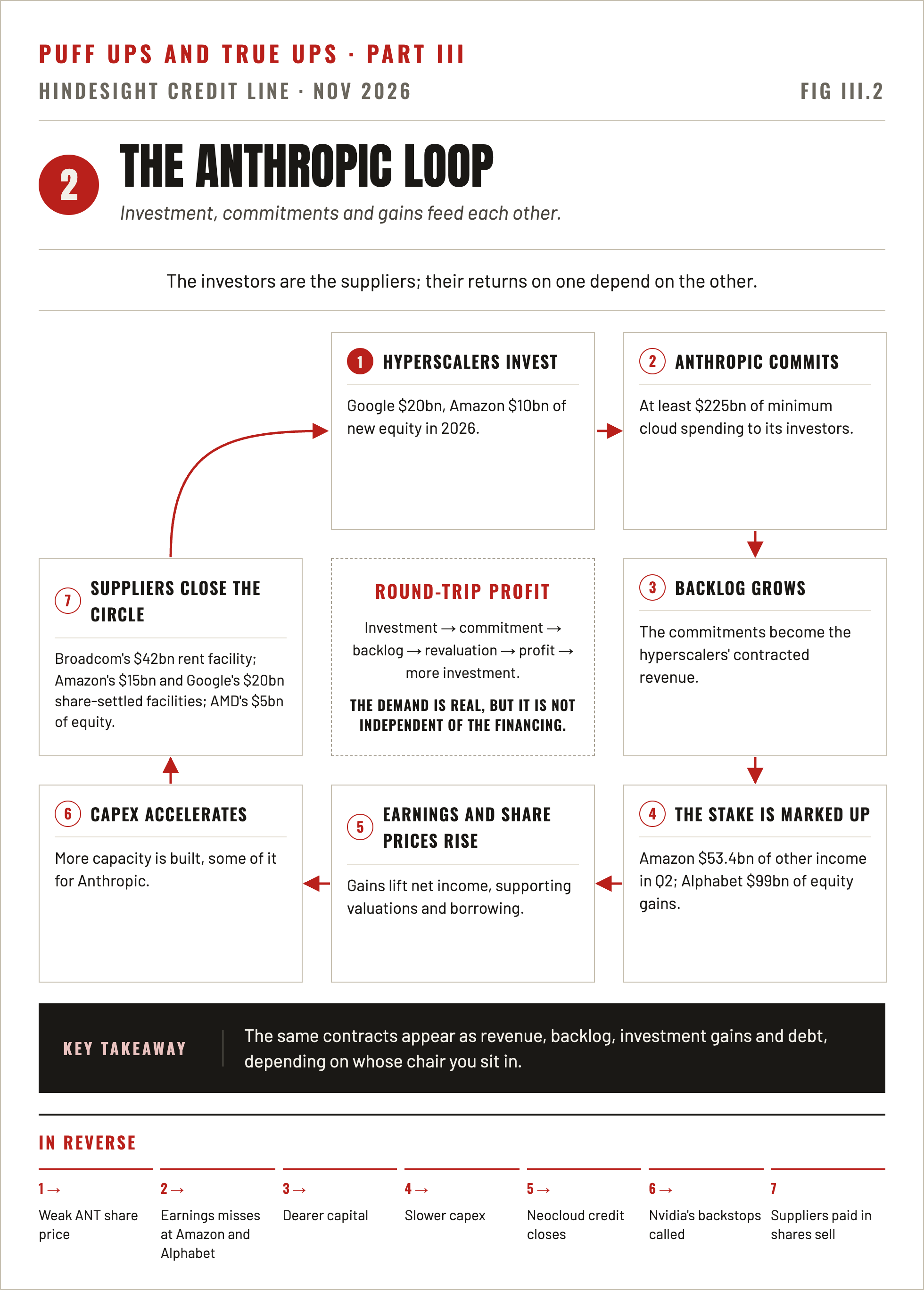
We have drawn these loops before. In August, A Credit Cycle Wearing AI's Costume traced three. In the wealth loop, AI expectations lift investment, profits and valuations, and rising valuations then fund more spending that appears to validate them. In the financing loop around Nvidia, cheaper credit buys more chips, more chip revenue strengthens the supplier, and a stronger supplier makes lenders more comfortable still. And in the contract loop, signed commitments become disclosed backlog, backlog becomes perceived visibility, and visibility raises the finance for the next round of contracts. The question we left open was how much financing it takes to produce the next dollar of revenue.
Anthropic's filing puts numbers on all three loops at once. The equity gains, the supplier facilities and the backlog are the same contracts seen from different chairs. And the August question now has a first answer: in the third quarter, each extra dollar of compute brought in about $1.21 of new revenue.
Even the headline loss belongs to the loop. Amazon's $6.2bn of convertible notes convert into about 1.84bn Anthropic shares at $2.09 and $5.05 each; at the roughly $58.90 a share implied by Anthropic's latest private round, that is about $108bn of stock (our arithmetic).1 Anthropic's $72.4bn first-half charge for the rising value of its notes is the same revaluation, seen from the other side of Amazon's gain.
This is reflexivity in George Soros's sense, where rising valuations fund the spending that justifies them. It does not make the revenue fictitious. It means the demand is not independent of the financing. The investors are the suppliers, and their returns on one depend on the other.
The loop also runs in reverse. Once Anthropic's shares trade, their price feeds Amazon's and Alphabet's earnings every quarter, so a weak stock becomes an earnings miss at two of the largest companies in the index. If credit closes to the neoclouds, Nvidia loses orders and its backstops are called. And suppliers paid in shares at a discount to the market tend to hedge by selling the stock short, which makes them steady sellers just when the price is weakest.
Those who are owed the most also have the least say. Anthropic's strategic investors hold non-voting shares. A single share held by the founders carries 50.1% of the votes, and the Long-Term Benefit Trust elects a majority of the board.1 The company has also set aside 5% of its fully diluted shares for its Public Benefit Fund, with up to 2% more each time the share price rises 50% above its last milestone.
A loop like this needs a place to keep the debt. That place is below the line.
Puff Ups and True Ups
The names are a gift. The vehicle behind Meta's Hyperion campus is Beignet; the one behind its El Paso campus is Sopaipilla. Both are fried dough that puffs up around a hollow centre. The beignet is French, dusted with sugar. The sopaipilla is its Spanish and New Mexican cousin, the same pastry with an extra drizzle of honey to sweeten it. Fittingly, the El Paso bonds came with more honey, at 7.534%, against Hyperion's 6.581%.
Special-purpose vehicles (SPVs) and joint ventures (JVs) exist for a reason. They deflect risk, and project it onto others. They protect the listed equity and the debt rating. Above all, they let a sponsor lever up, magnifying both the risk and the reward, and own more of what it needs, which in this cycle is the infrastructure that controls the compute, from raw supply to refined product, much as the majors once controlled oil from the well to the pump. No single company can own this market, and each knows it. As a group, they can, and the gearing is what keeps each of them in the game. The question to keep asking is not only who pays, but how the risk transfers at each interchange.
In October’s Below the Line I promised to explore how this credit is packaged, tranche by tranche, to reach the single-A ratings that let insurers hold it with little capital, and who ends up holding it. It has grown into a piece of its own, which follows later in November. The outline is already visible: vehicles that are mostly debt, rated on the strength of a hyperscaler’s lease or a chipmaker’s guarantee, sold to insurers whose record annuity sales are pouring hundreds of billions into exactly this kind of paper. As before, the proof is likely to arrive after the cycle turns, not before.
The Stack, Layer by Layer
Hyperion is the template. In October 2025 Meta formed a JV with funds managed by Blue Owl, which own 80% to Meta's 20%. Meta contributed $4.3bn of construction and land, Blue Owl's funds $7.0bn of cash, and Meta took about $3bn back. The JV's vehicle, Beignet Investor LLC, raised $27.3bn of bonds at 6.581%, amortising to 2049 and rated A+, with PIMCO holding about $18bn. Meta does not consolidate the JV. It shows an equity stake, leases starting in 2029 and a residual value guarantee (RVG), a promise to make up any shortfall in the campus's value when a lease ends.4
Each layer reports a respectable ratio. No layer reports the stack.
Fund-level borrowing makes the investor more fragile; it does not by itself remove the equity protecting the bonds.
Sources: Meta, Form 10-Q, Q2 2026; S&P; PIMCO; Ares, In the Gaps, 2026.4,5
Each layer reports a respectable ratio. No layer reports the stack. Meta looks unlevered on the asset, the JV looks like a well-secured project, the sponsor looks like an equity investor and the insurer like a high-grade bondholder. Look through all four and, on that sensitivity, the equity cushion is thin, and the residual risk rests on Meta's guarantee and the insurers' capital. Borrowing above a fund makes that investor more fragile; it does not by itself remove the equity protecting the bonds. As we set out in October's Below the Line, under the principle of where the boundary falls, Ares, which arranges and buys these structures, sums it up as the same transaction carrying opposite labels. The corporate's accountants see equity; the sponsor's lenders see debt.5
The terms make the point sharper still. Hyperion's leases have initial terms of four years, with options to renew.4 A four-year commitment supports a bond that amortises to 2049, at roughly $2.3bn a year of debt service (our arithmetic). The RVG bridges the gap, so the lenders' balloon rests on Meta, not on the building. Meta's two data-centre guarantees, at Hyperion and El Paso, come to about $41bn, with no liability recorded against either.
The market has noticed what the labels have not. Hyperion priced at par, 225 basis points over Treasuries, and has traded near 92 this month. On our tracker's yields of 23 October, Hyperion paid 31 basis points more than Meta's own bonds, El Paso 56 basis points more, and Oracle's Michigan vehicle 64 basis points more than Oracle.6 Some of that spread is maturity, liquidity and the bonds' own terms. Much of it is the price of the structure.
Scale it up and the sums change character. Moody's counts $1.2trn of hyperscaler lease commitments as debt-like, $820bn of them not yet started.7
North Star
Now to another piece of projection. I mean protection. Anthropic's TPU leases show the same machinery from the tenant's side. Its five-year leases with Broadcom, about $161.2bn of rent, are held in two special-purpose subsidiaries, one of them AI Infrastructure OpCo II, LLC. Anthropic guarantees them; they are secured on the chips and cross-defaulted; rent can start before the data centre is ready; and cash sits in a restricted account for Broadcom's benefit. Broadcom intends to pass the lease to a "designated financial partner", and has already assigned part of one existing lease to a third party, not named in the filing.1 The vehicle that will buy the chips, Project North Star, was announced on 26 October, a new SPV with $63bn of committed financing. Bank of America, Citi and Morgan Stanley are arranging the first-lien loans, reportedly about $43.5bn of the total; Blackstone is the sole provider of the committed second lien; and Broadcom gives the vehicle residual-value support equal to the first-lien amount. Deliveries begin in 2027. The deal nearly stalled. The Wall Street Journal reported that the banks balked, citing rising rates and the turmoil around the neoclouds, until Broadcom's chief executive, Hock Tan, conceded higher interest rates and stronger protection against losses if Anthropic defaults.8 The lenders would lend against Anthropic's rent only with Broadcom standing behind the chips.
Then comes the rent facility. Anthropic can issue up to $42bn of convertible notes to Broadcom, or its financial partner, solely to pay that rent, with interest added to the debt at 9%, rising to 13%, and conversion at 85% rather than 90% of the share price, in any period when Anthropic misses its revenue conditions. The right to draw also lapses if those conditions fail for long enough.1 In a mild slowdown, the facility pays the rent in paper on worse terms. In a severe one, it may not be there at all.
What that means for each side is easiest to see in numbers. Take $1bn of rent financed through the facility, held for five years and then converted into shares (an illustration, not a forecast).
HindeSight arithmetic from the terms in Anthropic's S-1. Illustrative only: actual dilution depends on how much is drawn, when, and the share price at conversion.
The right-hand column is the one that matters. The facility is generous to Anthropic when it does not need it and costly when it does, and if the revenue conditions fail for long enough, it may not be there at all. For the holder, the terms improve as the borrower weakens, which is precisely when the shares it receives are worth least, and when it is most likely to hedge by selling them.
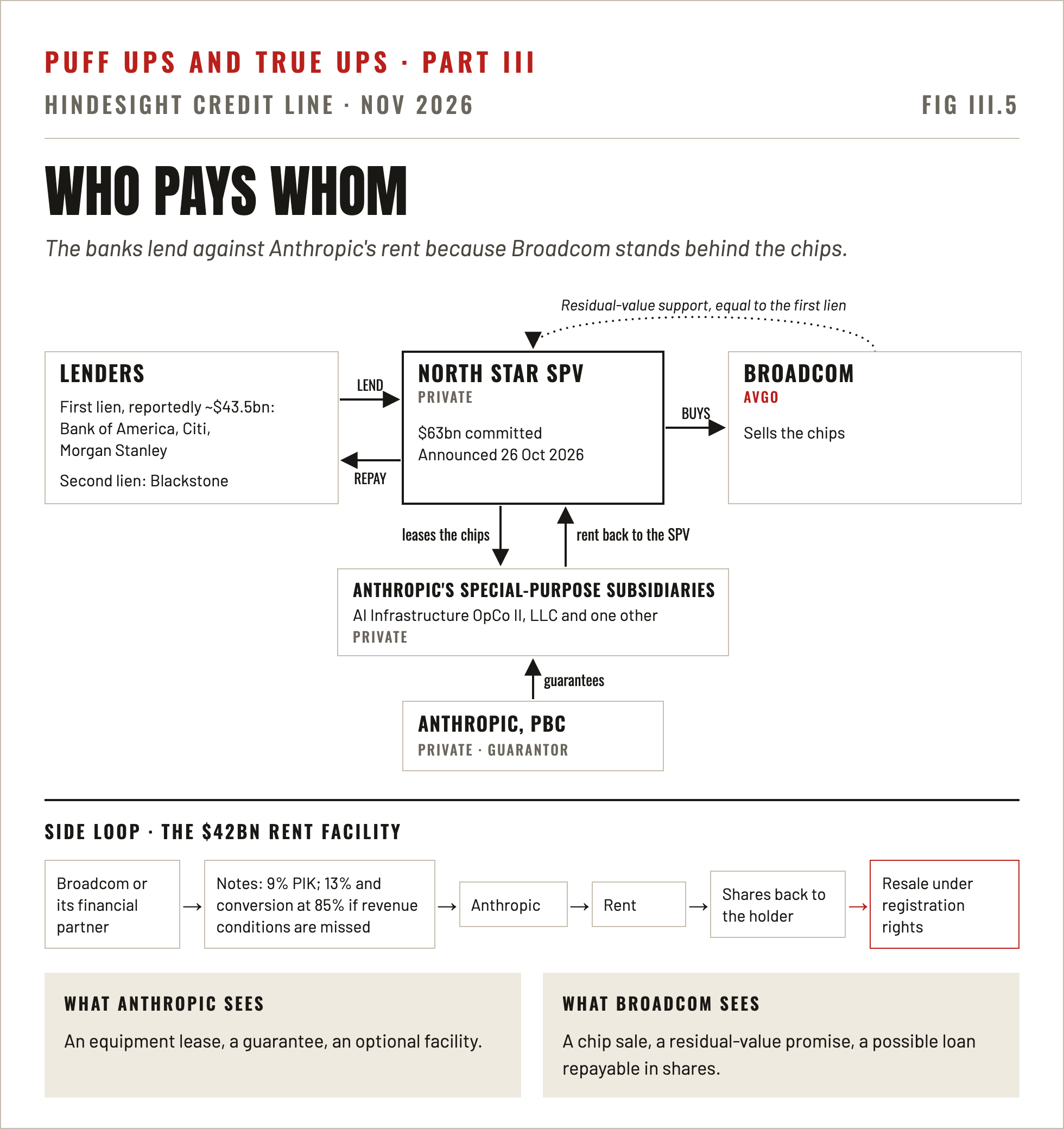
HS Chart NoteThe banks would lend against Anthropic's rent only with Broadcom standing behind the chips. Anthropic's guarantee carries the rent, the chips carry the residual value, Broadcom the backstop, and the lenders, perhaps an insurer behind them, the paper.
Open full size →Each layer carries a different risk. Anthropic's guarantee carries the rent. The chips carry the residual value. Broadcom carries the backstop. The financial partner, and behind it quite possibly an insurer, carries the paper.
True Ups
The structures puff up the capacity and the leverage. The true-ups decide who pays when usage or prices fall short. In a contract, a true-up makes the buyer pay any shortfall against its minimum. In accounting, it is the moment an estimate is reconciled to the actual figure, which is when the lag between the label and the risk finally closes. In the terms of October's Below the Line, this is where principle 1, signing is not recognition, and principle 4, guarantees disclosed at their maximum and booked near nil, meet their reckoning. The contractual true-up is itself one of the backstops described under principle 3, where the boundary falls, built to work like a guarantee without counting as one. A guarantee's maximum is not its accounting liability. Some, like Google's credit derivatives, are carried at fair value; others are recognised only when a loss becomes probable; and cash moves only when a contract's trigger is hit. The gap between what is disclosed and what is booked is worth watching. It is not, by itself, a loss waiting to be recognised.
Disclosed maximum against amount recognised. A gap worth watching, not by itself a loss waiting to be booked.
Some true-ups arrive on a timetable. The largest arrive only in stress, and are recorded last.
Sources: Anthropic S-1; Nvidia, Alphabet, Meta, Microsoft and Oracle filings, as set out in Below the Line, Oct 2026.1,9
The structures puff up the leverage. The true-ups decide who pays. And the order in which they land tells us how a credit cycle like this one unwinds.
The Minsky Ladder
It bears repeating, as it did in August and again in October's Catch-22, because it tells us exactly what to look for. Hyman Minsky sorted borrowers into three kinds. Hedge borrowers can repay both interest and principal from their income. Speculative borrowers can pay the interest but must refinance the principal. Ponzi borrowers can pay neither from income, and must borrow, or sell assets, to keep up. His insight, which sat inside Soros's reflexivity in our August letter, was that stability breeds instability, because the longer a boom runs, the more borrowers drift down from hedge to speculative to Ponzi, usually without anyone announcing it.
The AI build now has borrowers on every rung, and the dates show the drift.
The risk moves down the ladder. The holders move up the safety spectrum. The labels don't move at all.
Sources: SpaceX 8-K; Nebius 6-K; Anthropic S-1; Below the Line, Oct 2026, for Lambda, CoreWeave, Oracle, Nvidia, Google and Meta.10
A word of fairness. The Broadcom facility is drawn only if needed, and its revenue conditions sit far below anything Anthropic has yet reported. It is a structure built for a bad case, not evidence that the bad case has come. But Minsky's point was never that every borrower is a Ponzi unit. It is that a boom manufactures the structures that make the drift possible, and those structures frankly are sitting waiting.
In August we drew this as the Minsky Credit Accelerator Loop, showing how success migrates the financing system towards fragility, from hedge to speculative to Ponzi, and October's Catch-22 traced it in its "Dominoes" section, with The Transmission chart showing how one delayed project reaches five balance sheets, from the tenant to the insurer. Now two migrations are crossing. The risk is moving down the ladder, from hyperscalers with cash to joint ventures, neoclouds and SPVs that depend on refinancing. The holders are moving up the safety spectrum, as the bonds land with insurers and pension funds that hold them at amortised cost, under labels that say investment grade. The US insurance industry has about $9trn of invested assets, and record annuity sales are pouring hundreds of billions of new money into it, much of it looking for exactly this kind of paper.5 Apollo, which owns the insurer Athene, is SpaceX's lessor; PIMCO holds about $18bn of Hyperion; Blackstone is North Star's second lien.
What moves a speculative borrower down a rung is the window closing. Musk said on 25 October that debt markets had almost entirely shut for companies without revenue outside AI data centres. The same weekend, the banks behind North Star balked until Broadcom stood behind the chips. A speculative unit that cannot refinance becomes a Ponzi unit, or a casualty. The window does not have to shut completely for that to happen. It only has to cost more for the borrowers who need it most, and that is what the spreads already show.
The last line of defence for most of this paper is the balance sheets of the hyperscalers themselves. Which is why it matters that those balance sheets have started to change.
The Hyperscalers Turn Free-Cash-Flow Negative
For most of this cycle, the hyperscalers paid for the build out of their own cash and bought back their own shares with what was left. That is no longer true of all of them.
Amazon's free cash flow over the twelve months to June was minus $7.6bn, before counting the principal on its finance leases.11 Alphabet reported free cash flow of minus $5.9bn for its second quarter, as $44.9bn of capital spending outran $39.1bn of operating cash flow. Oracle reported minus $5.4bn for its latest quarter, and even that was flattered: $11.4bn of its $23.1bn of operating cash flow came from customer prepayments, and without them, on our arithmetic, its free cash flow would have been nearer minus $17bn. Meta followed in its third quarter, with free cash flow of minus $2.1bn as $34.9bn of capital spending outran $32.8bn of operating cash, and no shares bought back, against $3.3bn a year earlier.11 Even the cash flow that remains is flattered. Bonus depreciation, restored permanently in July 2025, lets the hyperscalers deduct servers and chips for tax in the year they buy them, so cash taxes fall while the build lasts. Amazon paid $8.3bn of cash tax in 2025 against $12.3bn in 2024; Alphabet $21.5bn against $27.4bn; Meta $7.6bn against $10.6bn.11 It works like an interest-free loan from the Treasury, though it is a timing benefit rather than a debt: the deferred tax comes back as capital spending slows, which is when cash is tightest.
Even these numbers are not like for like. As October's Below the Line set out, no accounting standard defines capital expenditure or free cash flow, and each company draws the line in its own place.
The definitions decide how close each company appears to the line, and the line is where the story is.
Sources: company earnings releases and 10-K notes, as cited in 11; Microsoft finance leases from its fiscal 2026 annual report, Note 13.
The differences are not small. Count Microsoft's finance leases as spending and its capital expenditure for the year rises from $115.9bn to about $140bn. The definitions decide how close each company appears to the line, and the line is where the story is. The figures also cover different periods, a quarter here and twelve months there, so they show the direction rather than a like-for-like comparison.
The borrowing came next. Amazon, Alphabet, Meta and Oracle sold about $194bn of bonds by July, against $108bn in the whole of 2025, and the market began to ask for more. The extra yield needed to clear new deals rose from about 2bp to 12bp, while order books fell from nearly five times covered to under two.12 S&P cut Oracle to BBB-, the lowest rung of investment grade, on 9 July.13
Then the equity. Alphabet sold $49.6bn of stock in June, $30.5bn of common shares and $19.1bn of mandatory convertible preferred, while its long-term debt rose from $46.5bn to $98.2bn in the first half; the package also included a $10bn private placement with Berkshire Hathaway.14 Meta's independent directors concluded this month that borrowing on the scale management had in mind could hurt the company's credit ratings, and its adviser pointed to less favourable debt markets for the hyperscalers. Meta needs to raise hundreds of billions of dollars over several years. Its answer was a new class of non-voting shares, which lets it sell equity without diluting Mark Zuckerberg's control, and on 26 October it launched the first instalment, $12.5bn of mandatory convertible preferred shares paying 6.5%, and $25bn of shares sold forward at $625 each, upsized from $22.5bn, for settlement by November 2027. With the underwriters' options, the total could reach about $43bn. Meta can settle those forward sales entirely in the new non-voting shares.15 Meta has also set out an at-the-market programme of up to $60bn of the new non-voting shares, to start once they trade early in 2027, which would take the total towards $95bn. Nvidia, AMD and Broadcom indicated non-binding interest in buying up to $5bn of it between them. Suppliers offering to buy a customer's shares so that it can keep buying their chips is vendor financing that has moved all the way up the chain.
When further debt threatens the rating, the next step is equity. When equity on that scale threatens control, the next step is equity that does not vote.
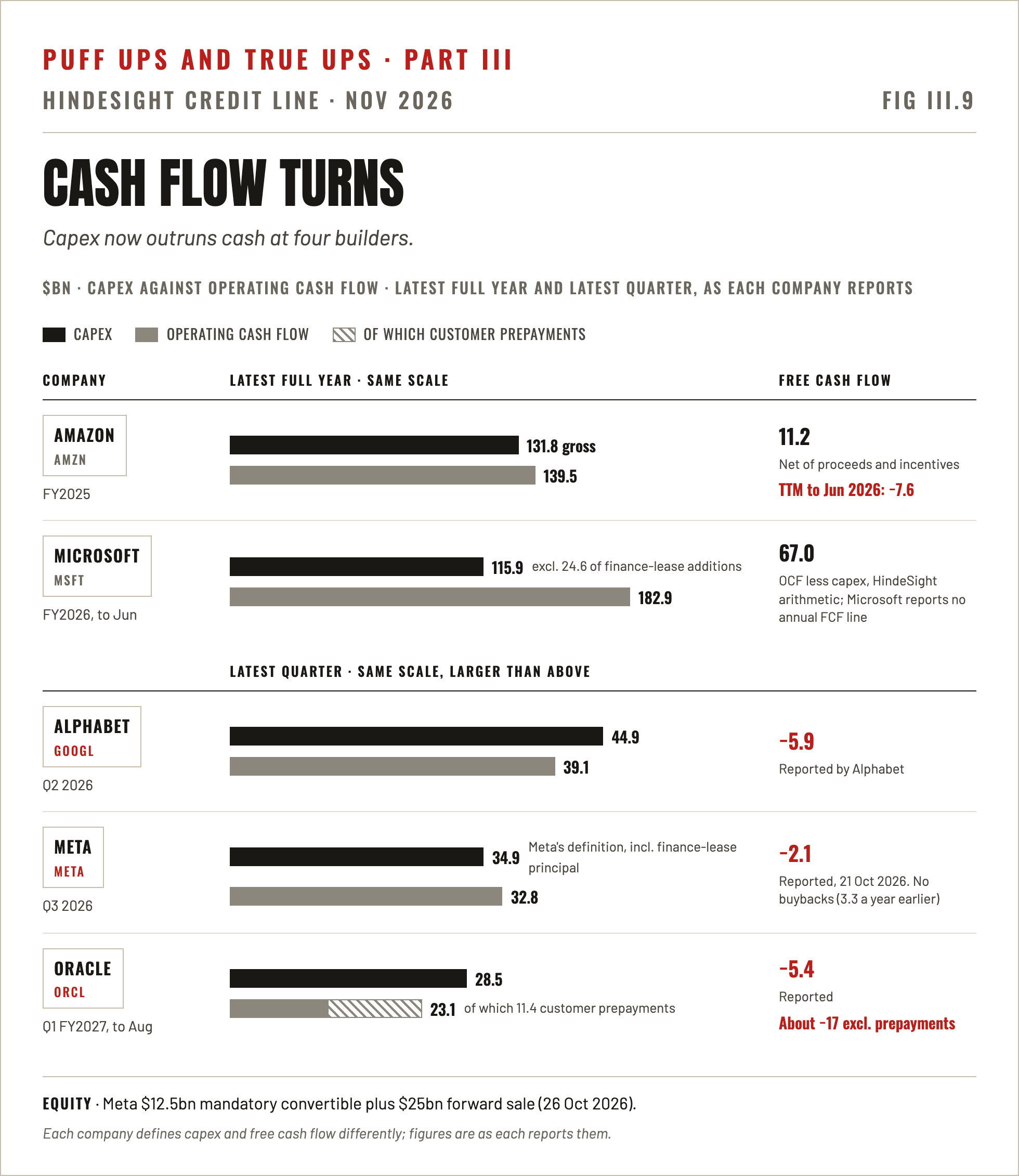
HS Chart NoteThe build was paid from cash, then from bonds, now from shares. When the last line of defence starts selling equity to pay for the front line, it is worth asking where the risk now sits.
Open full size →Anthropic's listing belongs to the same shift. Add SpaceX's $75bn listing, Alphabet's $49.6bn and Meta's $37.5bn, then the further $60bn Meta has set out and the roughly $100bn Anthropic is reported to be seeking, and the companies building AI have a pipeline of about $320bn of equity inside a year, some raised, some sold forward and some still to come.16 The bond market had already signalled its limit. Equity is the window still open, which is why so many are going through it at once.
And it comes on top of listings valued in the trillions. SpaceX listed in June at $135 a share, valuing it at about $1.77trn; Anthropic is reportedly seeking $1.5trn to $2trn; and OpenAI pitched a private round at $1.4trn before trimming its target to about $1.25trn.16 The companies involved are bound together much as Japan's keiretsu were in the 1980s, groups that held each other's shares, lent through a house bank and bought from one another. Cross-shareholdings lifted them together into 1989, and their unwinding weighed on Japanese shares for a decade afterwards. Here, too, the hyperscalers own the labs, the labs buy from the hyperscalers, and the chipmakers finance both.
There is no separate house bank, because the group is its own bank. Nvidia and Broadcom lend to, invest in and guarantee the customers that buy their chips; Amazon and Google fund the lab that rents their clouds, and are repaid in its shares; Google backstops the data centres that host the same lab's compute. The money goes round the circle. The outside lenders, Bank of America, Citi and Morgan Stanley, Apollo, Blackstone and Blue Owl, fund the circle rather than sit at its centre, and behind them stand the insurers, whose annuity holders play the part Japan's depositors once did.
None of this makes the hyperscalers weak credits. Their core businesses earn enormous sums, and their ratings are not in question tomorrow. But they are the last line of defence for almost every structure in this letter. They are the tenants behind the joint ventures, the guarantors behind the residual values, the investors behind the labs. When the last line of defence starts selling shares to pay for the front line, it is worth asking where the risk now sits, and who has been honest about it.
Where the Risk Sits
Put the pieces together and there is no single order in which losses would land. In an unguaranteed neocloud, the shareholders take the first loss and the lenders the next, holding short contracts and depreciating chips. Where a hyperscaler has guaranteed the rent or the residual value, as Meta has at Hyperion, the shortfall returns straight to its own balance sheet. Where a supplier has lent to its customer, as Broadcom may, the loss arrives first as a weaker loan or a falling share price. And an insurer holding a guaranteed bond has bought a different promise from one holding an unsecured loan against depreciating chips. The common feature is not the order in which losses arrive. It is how few balance sheets stand behind so many different promises.
The common feature is how few balance sheets stand behind so many different promises.
Sources: HindeSight Below the Line Tracker (unpublished); Forbes, citing FactSet and Morgan Stanley, Oct 2026.
The credit market is already pricing those promises. Credit default swaps (CDS), the cost of insuring against a default, put CoreWeave near 1,066 basis points and Oracle near 308, and SpaceX at a record 226.20,21 More telling is the top. On our tracker this week, Nvidia's CDS traded at 127 basis points, above Meta's at 119.22 The market now charges more to insure the chipmaker than the customer it supplies.
That is not hard to explain. Nvidia has written $108.5bn of guarantees, $36bn of agreements to buy back cloud capacity from its customers, and support for up to a quarter of the value of chips financed on its partners' platforms. It holds $99bn of equity investments, much of it in its own customers, and its receivables rose from $38.5bn to $63.1bn in six months.23 Every one of those exposures is largest exactly where its customers are weakest. If credit closes to the neoclouds, it reaches Nvidia first through lost orders, then through called guarantees, then through the marks on its investments, and from there to the suppliers whose $279bn of commitments it underwrites.
The shutoff does not stop at the guppies. It runs back into the names meant to hold the system up.
Prince Charming or Stand and Deliver?
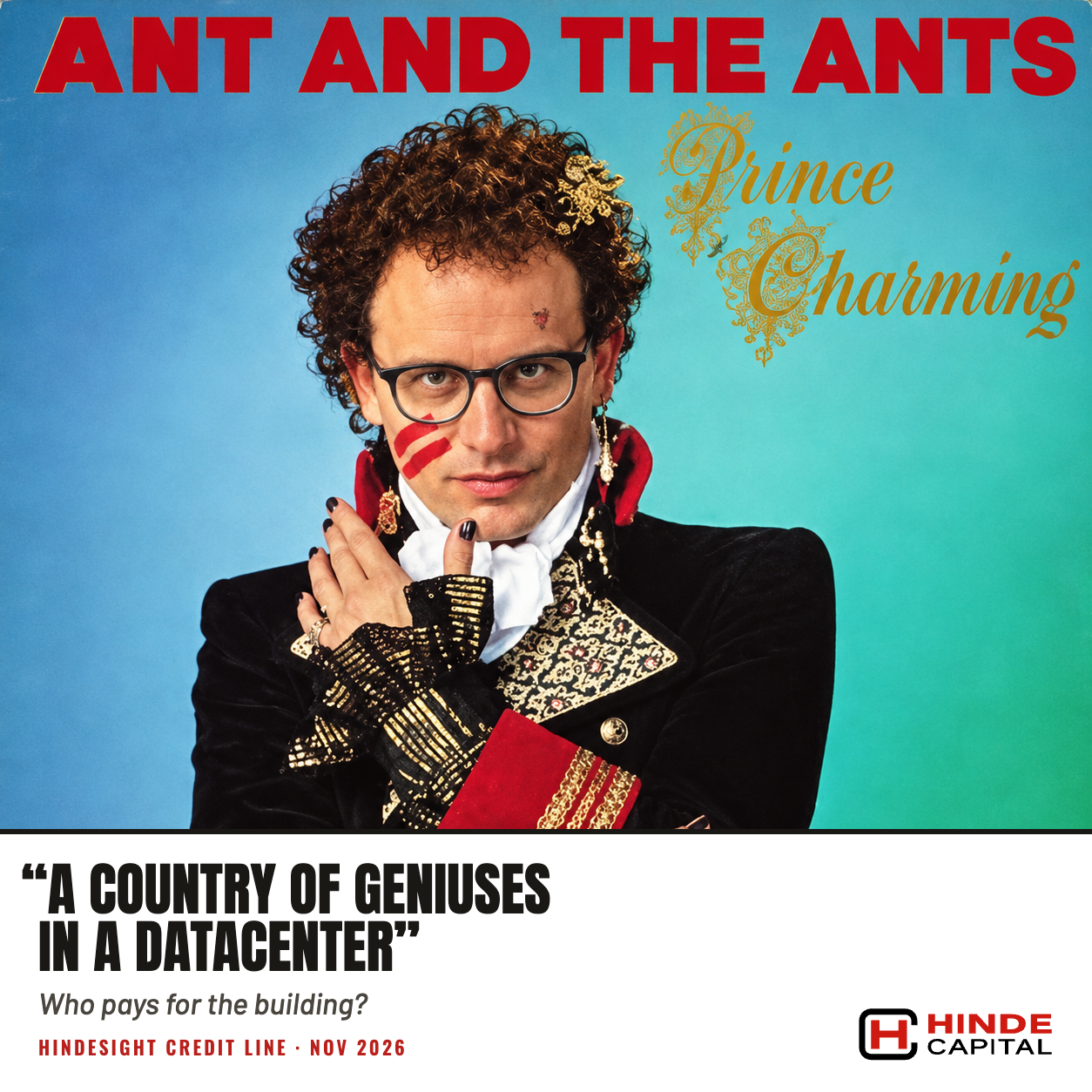
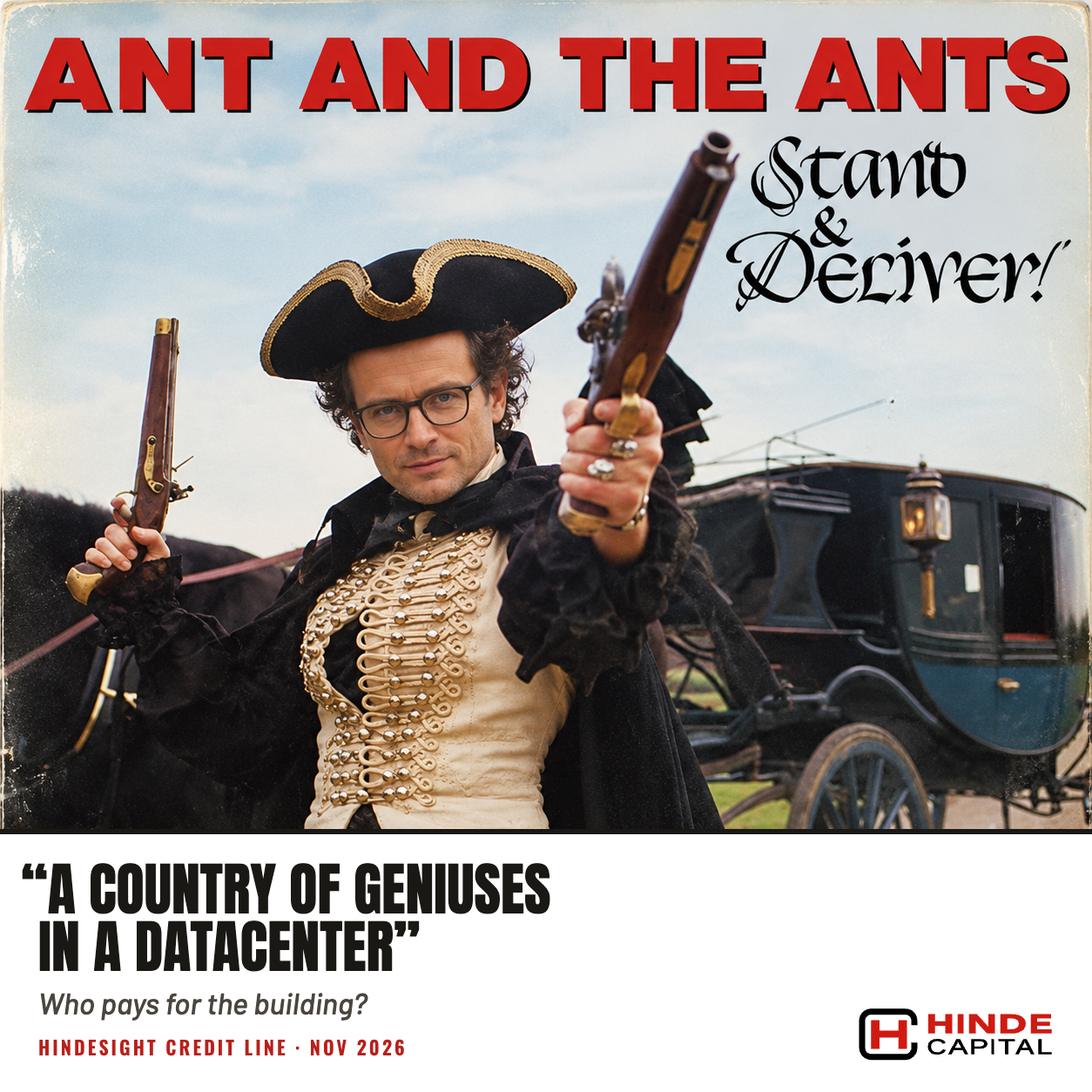
Prince Charming, or Stand and Deliver? Satirical illustrations, AI-generated; not photographs.
It is worth saying that the clearest list of these risks comes from Anthropic itself. Its filing warns that the company must stay at the frontier or lose its business; that it may not secure enough compute, or the chips and power behind it; that a handful of customers and channels drive much of its revenue; that its largest suppliers are also its investors, customers and competitors, and could compromise its access to compute; that its own models could be misused or act in ways no one intended; and that its share structure leaves public investors with little say.1
It is reassuring to have adults in the room saying this. It is not doom-mongering. Dario Amodei may have given his venture backers and the hyperscalers the odd moment of heartache, but he has also taken enough off the table to secure life-changing wealth and yet still has a great deal at stake. I do not agree with all his views, or his politics, but I find common ground, and I find it admirable.
His critics see something else. They accuse him, as they have Sam Altman, a quite different animal, of holding governments to ransom for protection, in the form of shields against liability and latitude on competition, much as Section 230 sheltered the platforms on which the internet of the 2000s was built. Section 230, part of the US Communications Decency Act of 1996, means online platforms cannot be treated as the publisher of what their users post, and protects them when they moderate in good faith. It let the platforms grow without carrying liability for their users' content. The counter is simple. Companies should own the liabilities they create.
My own view sits between. As in banking, some regulation and protection of consumers is warranted, and releases that require permission, like a banking licence or a drug approval, need not hold back development, even if adopted by the West alone while China and others decline to take part. The usual objection is that unilateral rules cede ground to those who ignore them. And permission governs what is released, not what is built. The labs keep training at full speed; only deployment waits for the licence. The cost of a short delay is small next to the cost of a failure serious enough to bring far blunter rules. Amodei's own position is closer to this than his critics allow. He argues for starting with limited rules, transparency first, and adding more only as the evidence demands. His example is California's SB 53, the Transparency in Frontier Artificial Intelligence Act, signed in September 2025, which requires the largest AI developers to publish their safety frameworks and report serious safety incidents.24
He also states his own Catch-22 plainly. Taking the time to build AI carefully, he writes, is "in genuine tension with the need for democratic nations to stay ahead".24 Too slow and the less careful win. Too fast and the machine outruns its handlers. It is the same dilemma this series has traced through the financing, seen from inside the lab.
Adam Ant's answer, in Prince Charming, was to hold to your standards and not fear ridicule for it.
[Lines from quotes/prince-charming.txt]
Adam and the Ants, “Prince Charming”, 1981
That suits a chief executive who puts misalignment and misuse in his own prospectus when it would be easier to leave them out. More Prince Charming than Dandy Highwayman, then, demanding that governments stand and deliver. The question for creditors is whether the structures built around him are held to the same standard.
[Lines from quotes/stand-and-deliver.txt]
Adam and the Ants, “Stand and Deliver”, 1981
What Would Prove This Wrong
The case against this letter deserves its strongest form. The demand is real, and the best evidence for it is the company at the centre of the piece. Anthropic made an operating profit in the second quarter and has lately broadened and diversified its customer base across the enterprise. Specialist models have barely begun, in the biosciences, where Anthropic has told investors it is investing heavily, and in AI applied to the physical world, from engineering to manufacturing, where Jeff Bezos's Project Prometheus is aiming. Cheaper tokens are being met with more use; in the four weeks to 11 October, spending with OpenAI and Anthropic rose 23% on 52% more volume.25 Each new chip lowers the cost of serving, so margins can hold even as prices fall, which is exactly what Anthropic says. The hyperscalers' core businesses throw off enormous cash. And the constraints cut both ways. Delay raises the value of capacity already built, and only a small share of planned gigawatts sits in places where local opposition is likely to stop it. If Anthropic reaches anything like the $190bn to $200bn of revenue it reportedly projects for 2028, today's commitments may well look prudent, not reckless.
That is a serious argument, and parts of it may prove right. Five signs would show it winning.
The first would be cash that covers the bill: operating cash flow, after replacing ageing chips, rising to meet the commitments as they start, at Anthropic and at the neoclouds. Cheaper borrowing would buy time, but only cash coverage would settle the question.
The second would be neocloud contracts lengthening, with interest falling as a share of revenue; CoreWeave's results, due around 12 November, are the first test.
The third would be token growth outrunning efficiency, so that demand for compute keeps pace with the capacity being built.
The fourth would come from Anthropic itself. A rebound in revenue per compute dollar from $1.70 in the fourth quarter, and a split of costs in the amended filing showing serving margins holding, would say the third quarter was capacity arriving early, not margins compressing.
And the fifth would be realised revenue per gigawatt converging on the scarcity price. If the $5bn to $17bn earned moved towards the $40bn to $50bn marketed, the bill would be affordable.
Four numbers will tell us more than any announcement of growth. They are realised token prices after discounts; the share of GPU hours actually paid for; the rate at which efficiency improves; and the rental yield a GPU owner needs to service its debt. When the first three move against the fourth, the credit breaks.
Who Pays for the Building
Amodei asked us to imagine a country of geniuses in a datacenter. Anthropic's filing shows that the country is real and growing at a pace few businesses have ever matched: about $16.9bn of revenue in a single quarter, customers in every industry, and models good enough to write most of their makers' code. Nothing in this letter disputes that.
What the filing also shows, for the first time, is the building. About $850bn of minimum commitments, against $10.8bn that customers have promised to pay. Firm minimums, agreements conditional on delivery and contracts that can be cancelled on notice. Suppliers that lend the rent and take it back in shares. Joint ventures that keep the debt off the balance sheet and guarantees that keep it off the income statement. And four of the largest builders now spending more than their operations bring in, and selling shares to make up the difference.
So who pays for the building? There is no single answer, and that is the credit problem. Some losses fall first on the neoclouds and their lenders. Others return directly to the hyperscalers through guarantees, leases and commitments. Behind the bonds and the private credit stand investors, among them the insurers and their annuity holders, whose exposure depends on the promises they have actually bought. And the same few companies keep appearing on both sides of those promises.
The geniuses will very likely be fine. The question is not whether they are real. It is whether the structure built to house them can survive the time it takes them to pay their way.
Appendix: Terms
| Term | Meaning |
|---|---|
| AI | Artificial intelligence |
| Backwardation | A futures or forward curve where later prices sit below today's; the market expects the price to fall |
| Basis point (bp) | One hundredth of a percentage point |
| Cluster | Thousands of GPUs in one data centre, networked to work as a single machine |
| Crack spread | In oil, the margin between crude and refined products; the compute crack spread is the margin between GPU rent and token revenue |
| Credit default swap (CDS) | Insurance-like contract on a borrower's default; its price is a market read of credit risk |
| Diffusion | Anthropic's term for the spread of its models through the economy |
| Distillation | Training one model on another's outputs |
| Finance lease | A lease that transfers most of an asset's economics to the lessee; recorded as debt-like on its balance sheet |
| Flip-flop | A circuit with two stable states that switches on a trigger; here, a compute market that is either short or glutted |
| FLOP | Floating-point operation, the basic unit of AI compute |
| GPU | Graphics processing unit, the chip most AI runs on |
| Hedge, speculative and Ponzi finance | Minsky's three stages: borrowers who can repay from income; who must refinance; who must borrow to pay |
| Hyperscaler | The largest cloud providers: Amazon, Google, Microsoft, and on some definitions Meta and Oracle |
| Inference | Running a trained model to answer users, as distinct from training it |
| Investment grade (IG) | A credit rating of BBB- or above |
| Label lag | Our term for ratings and accounting recognising risk last |
| Lessee | The party that rents an asset and pays the rent, such as Anthropic leasing TPUs or SpaceX leasing GPUs |
| Lessor | The owner of a leased asset, which receives the rent, such as the Apollo-managed entity that leases GPUs to SpaceX |
| Mixture of experts | A model design that splits its parameters into specialist sub-networks and uses only a few of them for each token, so it needs far less compute per token than a dense model of the same size, one that uses all its parameters every time |
| Neocloud | A specialist GPU cloud such as CoreWeave, Nebius, Nscale or Lambda |
| Neolab | A newer AI lab outside the frontier leaders |
| Paid in kind (PIK) | Interest added to the loan rather than paid in cash |
| Rate card | A seller’s published list prices. For AI models, the price per million input and output tokens a developer advertises for each model; what buyers actually pay is often lower, after discounts, cheaper models and caching |
| Recursive self-improvement (RSI) | AI helping to build its own successors |
| Reflexivity | Soros's idea that market prices change the fundamentals they are meant to reflect |
| Residual value guarantee (RVG) | A promise to make up any shortfall in an asset's value at the end of a lease |
| Run rate | Current revenue scaled to a year |
| S-1, 8-K, 10-Q | US filings: listing prospectus, notice of a material event, quarterly report |
| Section 230 | Part of the US Communications Decency Act of 1996; shields online platforms from liability for what their users post |
| Special-purpose vehicle (SPV) / joint venture (JV) | Separate entities used to hold assets and debt off a sponsor's balance sheet |
| Take-or-pay | A contract where the buyer pays for a minimum whether or not it uses it |
| Token | The unit of text a model reads or writes; inference is priced per million |
| Token price index (Ornn) | Ornn’s daily measure of what buyers actually pay for one developer’s tokens: total dollars paid divided by total tokens bought, across all its models, in dollars per million tokens. Because it is a realised average rather than a rate card, it falls when prices are cut, when buyers move to cheaper models, or when more tokens are cached or read rather than written. On 25 October, buyers paid an average of $0.27, or 27 cents, per million OpenAI tokens |
| Total cost of ownership (TCO) | The all-in cost of running a system, including the cost of capital |
| TPU | Tensor processing unit, Google's AI chip |
| True-up | Paying the shortfall against a contractual minimum; in accounting, reconciling an estimate to the actual |
| Utilisation | The share of hours a GPU is doing paid work |
| Valuemaxxing | Judging AI by the value of work done rather than tokens used; the backlash to tokenmaxxing |
Sources
- 1Anthropic, PBC, Form S-1, 26 Oct 2026. Used for: risk factors (p.58), Notes 9 and 17, MD&A; the $108bn is HindeSight arithmetic; Notes 7, 9 and 13, MD&A; Risk Factors Summary, pp.15–16. Form S-1 ↩ a b c d e f g h i
- 2Microsoft, Nvidia and Anthropic, partnership announcement, 18 Nov 2025. Microsoft ↩
- 3Amazon and Alphabet, Forms 10-Q, Q2 2026, as set out in Below the Line, HindeSight Credit Line, Oct 2026; Microsoft figure. Below the Line ↩
- 4Meta Platforms, Forms 10-Q, Q3 2025 and Q2 2026, as set out in Below the Line, HindeSight Credit Line, Oct 2026; the 3.3 to 1 and $2.3bn are HindeSight arithmetic. Below the Line ↩ a b c
- 5Ares Management, In the Gaps, Fall 2026. Ares, In the Gaps (PDF) ↩ a b c
- 6HindeSight Below the Line Tracker (unpublished), FINRA TRACE yields, 23 Oct 2026. ↩
- 7Moody's, via CNBC, 24 Jul 2026. CNBC ↩
- 8Bank of America, Blackstone, Citi and Morgan Stanley, announcement on Broadcom investor relations, 26 Oct 2026; Wall Street Journal, 27 Oct 2026, via Data Center Dynamics; first-lien size via GuruFocus. Data Center Dynamics ↩
- 9Below the Line, HindeSight Credit Line, Oct 2026. Below the Line ↩
- 10Space Exploration Technologies Corp., Form 8-K, 26 Oct 2026; Nebius Group N.V., Forms 6-K, Jul and Oct 2026; Anthropic, PBC, Form S-1, 26 Oct 2026; Below the Line, HindeSight Credit Line, Oct 2026. Form S-1 · Form 8-K · Below the Line ↩
- 11Amazon, Q2 2026 earnings release, 30 Jul 2026; Meta, Q3 2026 results release, 21 Oct 2026; Alphabet, Q2 2026 earnings release (SEC Exhibit 99.1), reconciliation to free cash flow; Oracle, Q1 FY2027 earnings release, 10 Sep 2026, free cash flow table; cash taxes from company 10-Ks, as set out in Below the Line, HindeSight Credit Line, Oct 2026, principle 8. Amazon Q2 release · Alphabet Q2 release · Oracle Q1 FY2027 release · Below the Line · Meta Q3 release ↩ a b c d
- 12Reuters, 29 Jul 2026, on hyperscaler bond issuance. Reuters ↩
- 13S&P Global Ratings, Oracle downgrade, 9 Jul 2026. S&P Global Ratings ↩
- 14Alphabet, Form 10-Q, quarter ended 30 Jun 2026. Alphabet 10-Q ↩
- 15Meta Platforms, Schedule 14C, 21 Oct 2026; Meta Platforms, free writing prospectus and prospectus supplement (424B5), 26 Oct 2026, and pricing release, 26 Oct 2026. Meta FWP · Meta 424B5 · Meta Schedule 14C ↩
- 16Reuters, 11 Jun 2026, on SpaceX's listing; Irish Times, 26 Oct 2026, on Anthropic's target valuation and raise; Financial Times, 22 Oct 2026, on OpenAI's round. Reuters on SpaceX · Irish Times on Anthropic · FT on OpenAI ↩ a b
- 17Microsoft, Form 10-Q, quarter ended 30 Sep 2026, cash flow statement and Note 12; spending including finance leases and the lease multiple are HindeSight arithmetic. Microsoft 10-Q ↩ a b
- 18Microsoft, fiscal 2026 fourth-quarter earnings call, 29 Jul 2026, remarks by Amy Hood, CFO; Reuters, 29 Jul 2026, on Microsoft's lease accounting change. Reuters (via The Star) · Reuters ↩
- 19Alphabet, Q3 2026 earnings release (SEC Exhibit 99.1) and earnings call, 28 Oct 2026; capex to depreciation is HindeSight arithmetic. Alphabet Q3 release ↩
- 20Financial Times, via Financial Post, "AI debt worries spark surge in default insurance trading", 20 Oct 2026. Financial Times · Financial Post ↩
- 21Bloomberg prices, Oct 2026. ↩
- 22HindeSight Below the Line Tracker (unpublished), Oct 2026. ↩
- 23Nvidia, Form 10-Q, Q2 FY2027, as set out in Below the Line, Oct 2026; Nvidia statement on residual-value support, Aug 2026. Below the Line ↩
- 24Dario Amodei, Machines of Loving Grace, 2024; The Adolescence of Technology, 2026. Machines of Loving Grace · The Adolescence of Technology ↩ a b
- 25Ramp data, via TMT Breakout, 22 Oct 2026. TMT Breakout ↩
The small print. Worth a read.
This is not investment advice. HindeSight is one person’s attempt to make sense of the world and its markets. As a trader, I will invariably have positions that reflect some of the views expressed here, so there will be occasions when I am talking my own book. I make no apology for that, but it is something the reader should be cognisant of.
I write HindeSight as much for my own edification as anything else. The process of committing thoughts to paper forces me to test a thesis, join a few dots and occasionally discover that some of the dots had no business being joined in the first place. If, in doing so, it helps others frame their thinking or piques their curiosity, all the better.
There is no prescribed publication schedule. The letters tend to be born out of curiosity, conviction or an intellectual itch that needs scratching.
Markets are dynamic and so, by necessity, are my views. It is perfectly conceivable to be tactically bearish and thematically bullish on the same market. Equally, what seemed a compelling proposition on Monday may look rather less so by Friday. There is little virtue in remaining faithful to a thesis simply because one has committed it to paper. The art of trading, as ever, lies in marrying conviction with flexibility.
The objective is not to be proved right, but to make a return commensurate with the risk undertaken, capturing as much of the opportunity as possible whilst giving as little back as possible. Easier said than done, as most of us who have spent a lifetime in markets can attest.
Hinde Capital no longer manages external capital and there is nothing here to sell you. These letters are shared in the spirit of intellectual curiosity and the enjoyment of exchanging ideas. By all means challenge my thinking, but do your own work, take responsibility for your decisions and never take more risk than affords you a decent night’s sleep.
Nothing published here constitutes an offer, solicitation or recommendation to buy or sell any investment or financial instrument. Past performance is no guide to future returns. Readers should seek independent, regulated financial advice where appropriate. To the extent permitted by law, no liability is accepted for losses arising from reliance on this material.
By all means share the letters with your sister-in-law or brother-in-law. Whether you remain on speaking terms is, however, beyond the remit of this disclaimer.
© Hinde Capital 2026.