
Part I ended on a question of price. Whether the bill for the building can be met depends on two of them, the rent on compute and the price of the tokens it produces.
Flip-Flop
First, a word on terms. A FLOP is a floating-point operation, a single calculation on decimal numbers. It is the basic unit of artificial intelligence (AI) compute. Training runs are measured in total FLOPs, and chips in FLOPs per second. A flip-flop is something else entirely, and no, this is not a section about rubber footwear, nor about whether AI is one big flop.
A rough calculation shows the scale. A widely used rule of thumb is that training a model takes about six FLOPs for every parameter (the model's adjustable weights) for every token of text it learns from. Take a dense model, one that uses all of its parameters for every token, with one trillion parameters trained on 20 trillion tokens.
Illustrative compute equivalents, HindeSight arithmetic using the standard rules of thumb. The cluster figure assumes all 100,000 GPUs sustain that effective rate after communication and other overheads; the single-GPU figure is a compute equivalent, not a feasible training run. The serving figure is not a response time: actual speed also depends on memory capacity and bandwidth, batching and context length. A mixture-of-experts model that uses about a tenth of its parameters for each token would cut both the training and the serving figures roughly tenfold.
The first rows explain why training needs clusters of tens of thousands of chips. The last explains how a GPU rented by the hour becomes a price per million tokens, and why everything that follows turns on how many tokens each GPU-hour can produce.
In electronics, a flip-flop is the circuit that stores a single bit of memory. Three of its properties matter here. It is bistable, with two stable states, high and low, and it stays in whichever it is in until something triggers a change. Its output depends not only on what is happening now but on the state it was last left in; it remembers. And it is edge-triggered, changing state only on the rising or falling edge of a clock signal, not gradually.
The market for AI compute behaves the same way. It is either short or glutted, with little stable ground between. It remembers its last state, since rents, contracts and loans are all set on the conditions of the shortage. And it does not drift from one state to the other. It flips on an edge, when a wave of capacity is switched on, a new chip generation ships, or a debt falls due. The H100 has already done it once, renting for about $8.50 an hour in 2023 and about $3 by 2025.1 This autumn it is edging up again, and its successors are scarce. The question is not whether the market flips back. It is when the next edge arrives, and who has borrowed against the current state.
The Price of Compute
Two prices are quoted for a graphics processing unit (GPU) hour, and they are often confused. The spot or short-term rent is what a GPU costs today for a few months. It is set by scarcity, and it is what most headlines show. On 21 October, Ornn's compute price index put a B200 at $9.40 an hour, an H200 at $5.88, an H100 at $3.09 and an A100 at $1.07.2 The term rent is what is locked in for years, and it is what lenders lend against. In late October a one-year contract for a B200 was marked at about $5.67 an hour, against about $9.40 on the spot market; longer marks are not public.2
Headline rents and the price at which a spare hour actually clears can sit a long way apart. Nebius raised its list price for a B300 from $7.85 to $9.50 an hour on 1 October, then moved its spot market to an auction that, in its founder's words, raises prices every 12 minutes. On 28 October that auction priced an interruptible B300 hour in its US region at $1.50, down 65% in thirty days and about a sixth of the list price, and an H100 in Finland at $1.00, down 54%. The same week, Ornn's B200 index set a record near $9.70.3 One is a single provider's spare capacity in one region, the other a market-wide index, so the comparison is illustrative. But it is the flip-flop in miniature: the same chips, priced as scarce and as surplus in the same week.
The curve slopes down. Spot is high and term rents are lower. In commodity language the curve looks backwardated, though this is not a conventional futures market. A committed year is worth something to the seller because it secures utilisation, so the discount reflects contractual certainty as well as expectations that compute will get cheaper.
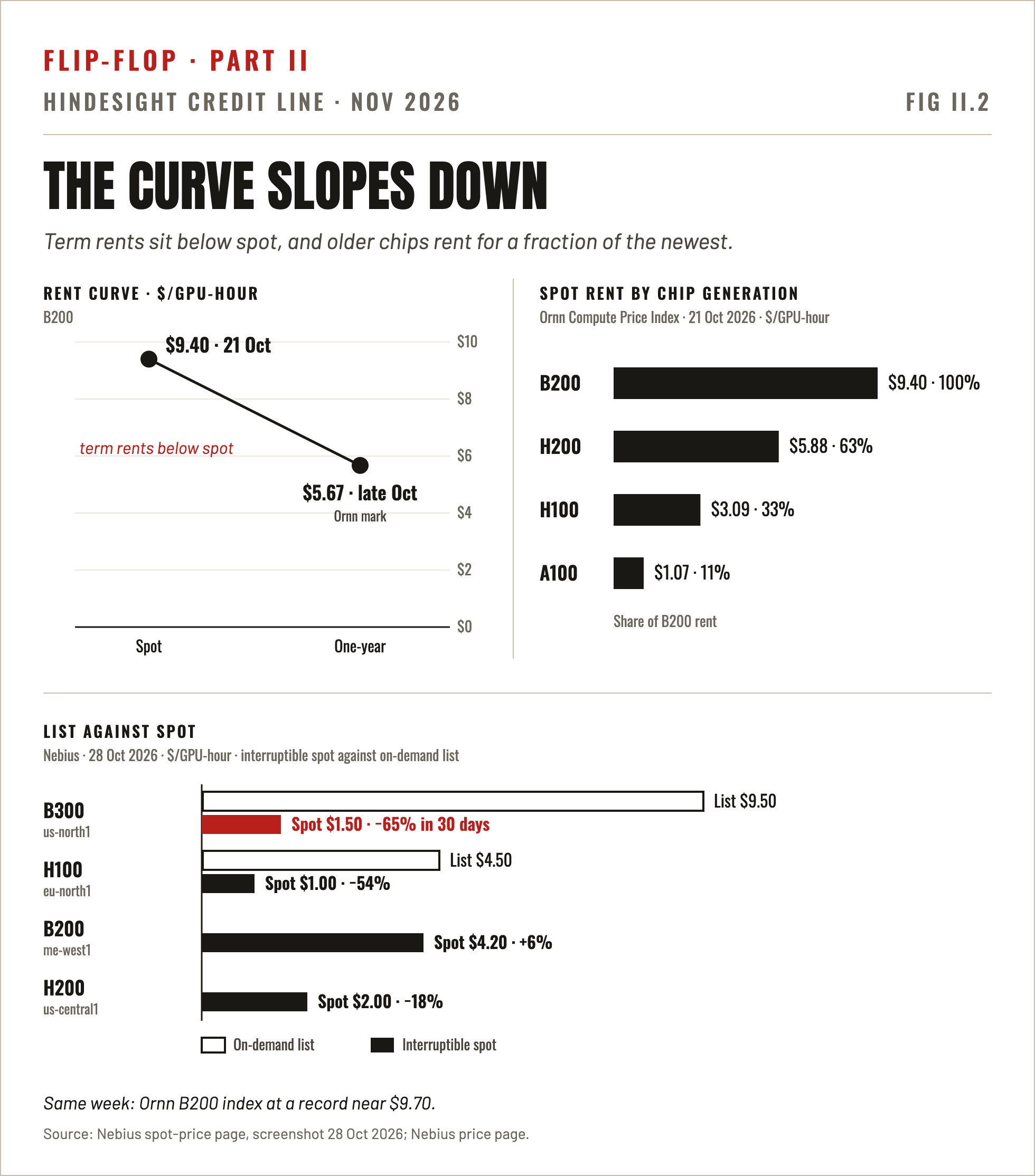
HS Chart NoteThe curve is in backwardation: the market expects compute to get cheaper. And each new generation pulls the old ones down; an A100 now rents for about a ninth of a B200. Loans against older fleets were sized on the rents they earned when new.
Open full size →This autumn produced a pair of lines that could stand for the whole cycle. Between the end of June and mid-October, Ornn's B200 rental index rose 82%, from $4.46 to $8.12 an hour, and on 25 October it reached a record $9.70. Over the same weeks, CoreWeave's shares fell 38%.2 Rents rose because capacity is late, held up by power, memory and buildings, and because some holders are hoarding it to re-let. The neoclouds fell because most of their capacity is already sold forward at fixed prices; their backlogs do not reprice when spot rises. That is the neocloud's trap. The best-paying contracts it can sign today are short, three to six months, and short contracts are the least financeable, because lenders size GPU loans on long take-or-pay contracts with investment-grade tenants.
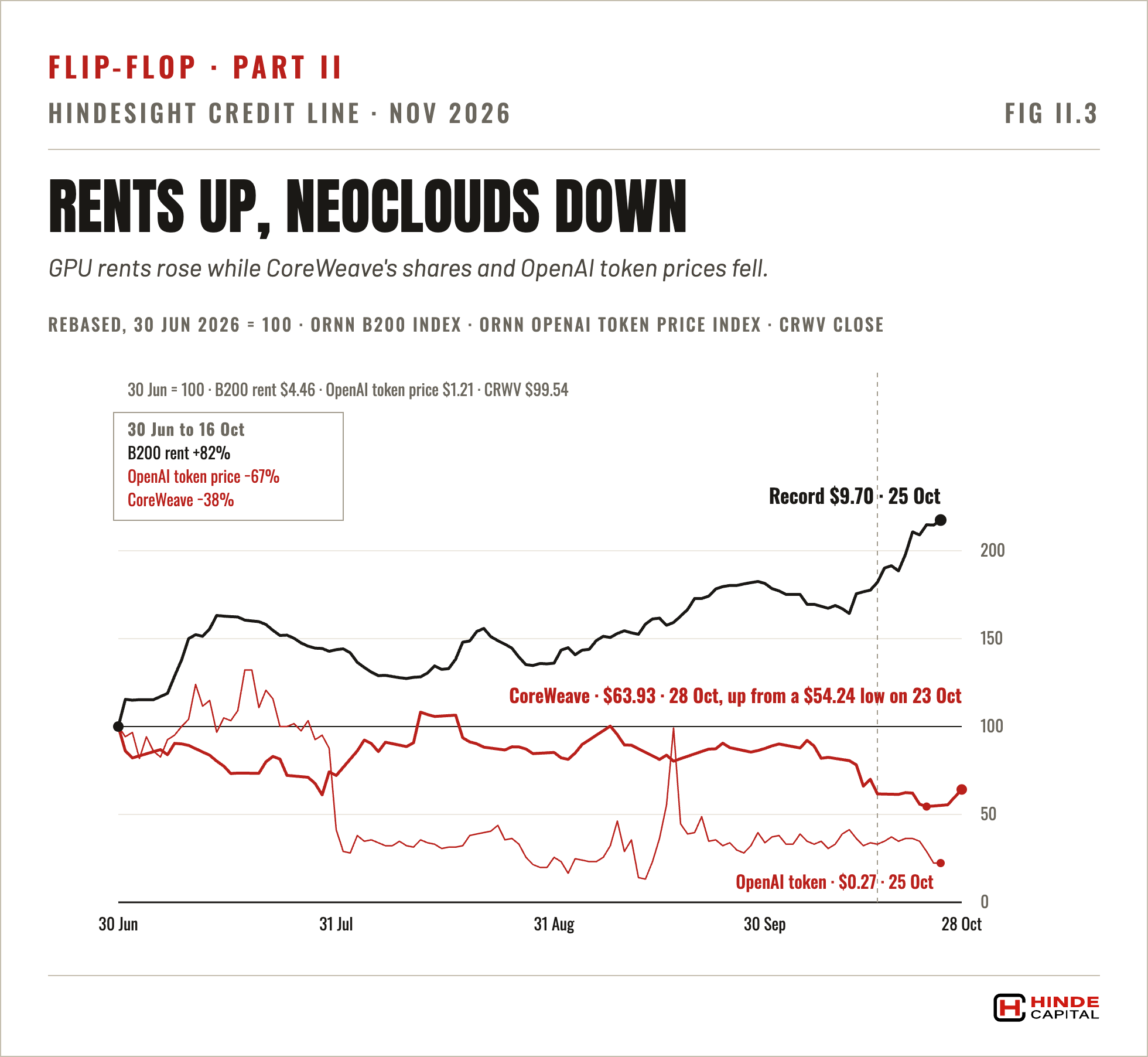
HS Chart NoteRents rose because capacity is late, and some holders are hoarding it to re-let. The neoclouds fell because their capacity is sold forward at fixed prices. Their backlogs do not reprice when spot rises.
Open full size →The gap between what is marketed and what is earned is the scarcity premium. Providers market short-term capacity at $40bn to $50bn a year per gigawatt. Realised revenue across the labs and neoclouds runs at $5bn to $17bn.4 Scarcity pricing applies to a slice of capacity, not the fleet.
And every new generation pulls the old ones down. On Ornn's curve, an H200 rents for about 63% of a B200, an H100 for about a third and an A100 for about a ninth. The loans against older fleets were sized on the rents they earned when new.
The Price of a Token
Training builds a model. Inference is everything that happens afterwards. Each time a customer asks a model to write code, read a contract or run an agent, the model computes an answer, and every answer consumes compute. Following the commodity curve of compute, think of an inference provider as a refinery. It buys its crude, the GPU-hour, at an hourly rent, runs a model on it, and sells the product, tokens, by the million. Its margin is the gap between the two, what we will call the compute crack spread.
In energy, a refiner buys crude and sells refined products such as petrol and diesel. The crack spread, named after the cracking process that breaks heavy hydrocarbons into lighter ones, is the value of the products less the cost of the crude, often quoted as the 3-2-1 spread, in which three barrels of crude are refined into two of petrol and one of diesel. Refiners do not live on the oil price; they live on the spread, and it swings with their run rates and with how many refineries compete for the same crude and flood the same product market. Inference works the same way. The provider lives on the gap between the GPU-hour it rents and the tokens it sells, scaled by how many tokens each GPU-hour yields.
Ornn's index of what buyers actually pay for OpenAI's tokens shows the other blade. The average price per million tokens fell from $1.21 at the end of June to $0.27 on 25 October, down almost four-fifths, while the rent on a B200 more than doubled. A lower price does not necessarily mean a lower margin, because a smaller model also costs less to run: if buyers are moving to cheaper models, the cost of each token falls with its price. But to the extent the fall comes from price cuts or cached tokens, the same hardware earns less while it rents for twice as much, and the compute crack spread is squeezed from both ends. The input, an hour of GPU time, costs more, while the output, each token, sells for less, so the margin between them narrows from both sides at once.2
These two indices are not themselves a measured crack spread; they price different things. The realised spread depends on which model is served, how much computation it needs, how many of the GPU's hours are sold and what the customer actually pays. The indices show why the squeeze is worth measuring, not its size.
There is an escape valve. Anyone holding capacity on a fixed rent below today's spot price can re-let its spare hours at a profit, and some are doing exactly that. But it works only while compute is scarce. When the market flips, everyone with spare hours tries to sell them at once; this week Nebius's own auction cleared a B300 hour at a sixth of its list price while the index sat at a record.3
The rent is paid every hour, busy or idle. Revenue arrives only when customers are using the GPU. Utilisation therefore decides everything. Take a GPU rented at $8 an hour that could produce $20 of tokens an hour at full load. At a quarter of capacity it loses money. At half it makes a thin margin. Only near full use does it earn a healthy one. On published estimates, the utilisation needed simply to break even ranges from about 7% to more than 30%, depending on the chip, the model and how fast each user is served.5 Serving each user faster means fewer users per chip, and fewer tokens to sell.
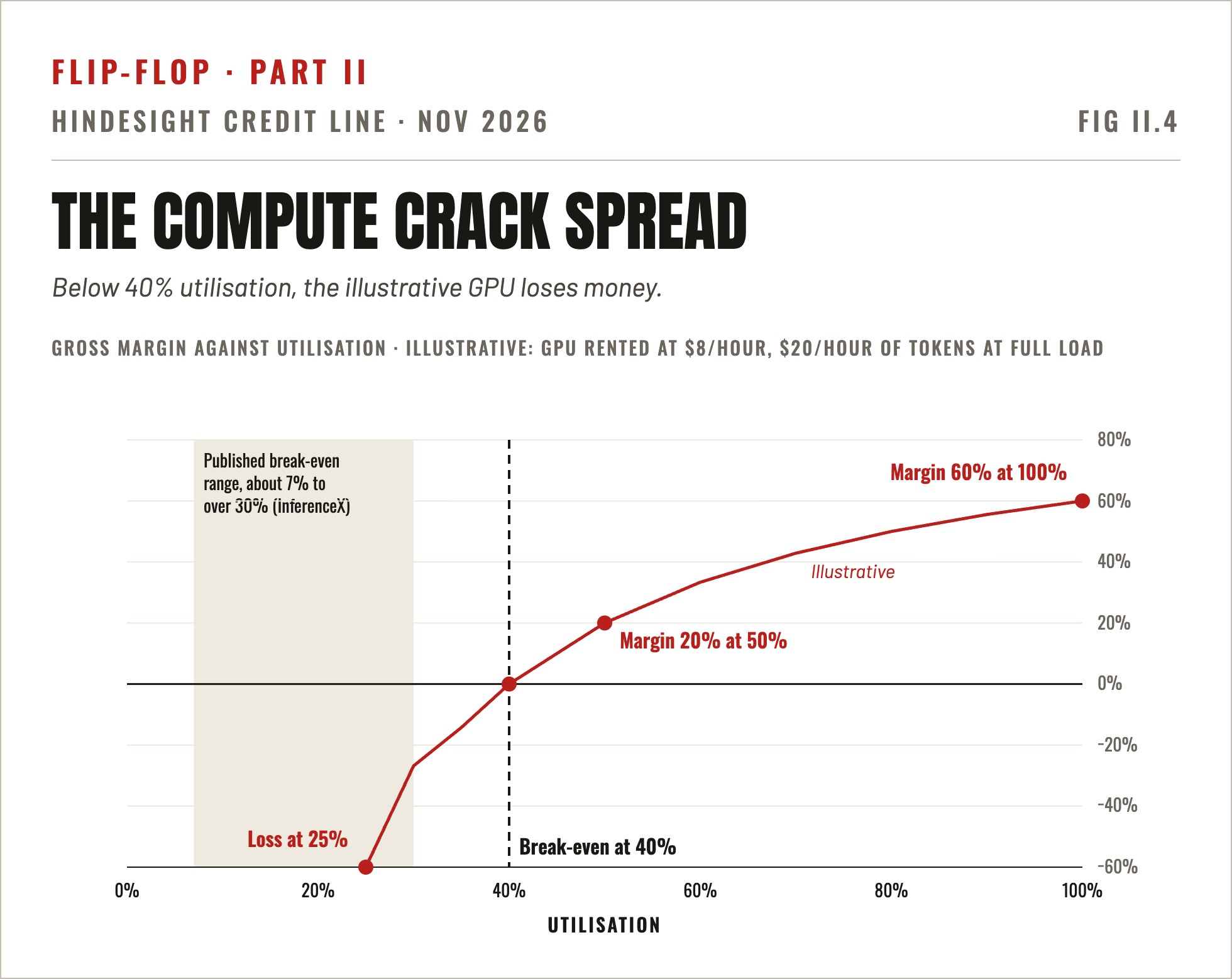
HS Chart NoteThe rent is paid every hour, busy or idle; revenue arrives only when the GPU is in use. Utilisation decides the margin. Serving each user faster means fewer users per chip and fewer tokens to sell.
Open full size →Today the spread is wide, which is why dozens of new providers are appearing each month, some assembled in weeks on rented clusters. A cluster is thousands of GPUs in one data centre, wired together with high-speed networking so they work as a single machine. Training a frontier model needs the largest; serving one can be spread across smaller ones. Amodei expects the clusters that train powerful AI to be large enough, by around 2027, to run millions of copies of it at once.6 More refiners bid up the crude and flood the market with product. This autumn's data show both sides of that squeeze, with GPU rents up and Ornn's index of Anthropic's token prices down by half in a month.2 The routers that allocate demand between providers accelerate it. OpenRouter, the largest public marketplace, sends traffic in proportion to the inverse square of a provider's price, so a small price cut wins a disproportionate share of orders.7 The plumbing rewards undercutting.
One more feature makes the industry look bigger than it is. A customer spends $100 on inference. The provider books $100 and pays perhaps $50 to a GPU cloud, which books $50 of its own. That is $150 of reported revenue from $100 of final demand.
Every New Chip Resets the Price
Nvidia's first Vera Rubin results on the largest open model show more than three times the throughput of the GB300 systems now being installed, at about 1.7 times the hourly rent. That is roughly 1.8 to 2 times as many tokens for each dollar of total cost of ownership (TCO), the all-in cost of running the system, including the cost of capital.8
TCO is usually expressed per GPU-hour, and it adds up everything needed to keep that GPU earning. The chips and servers themselves are by far the largest item, roughly 60% of AI data-centre capital spending on McKinsey's split, with power and cooling about 25% and land and buildings about 15%.9 Add the networking that ties them into a cluster, the data-centre shell and fit-out (or the rent for space in someone else's), power, maintenance and staff, depreciation, and the interest on the money borrowed to buy it all.
Each input is an assumption someone can tune. Stretch the chips' depreciation from four years to six, or to the eight some in the industry now argue for, and the hourly charge falls sharply. Assume lower utilisation, and the cost of each useful hour rises. Raise interest rates, and TCO rises with them, so the boom's cost of capital shows up directly in the price of a token.
Once the new chips are widespread, token prices settle at their economics, not the old ones. A GB300 fleet financed in 2025 or 2026 will then need near-full utilisation to earn what it was underwritten to earn. Good for the customer. Less good for whoever lent against the older fleet.
More Tokens, Fewer GPUs
This is where the price of a token meets the credit cycle.
Suppose usage grows twentyfold. If prices for equivalent work fall 90%, revenue doubles. If they fall 95%, it is unchanged. Demand for GPUs depends on something else again, the number of tokens each GPU-hour produces. If efficiency improves tenfold over the same period, twenty times the tokens need only twice the compute. The size of the build has to be judged against that requirement, not against the growth in tokens alone.
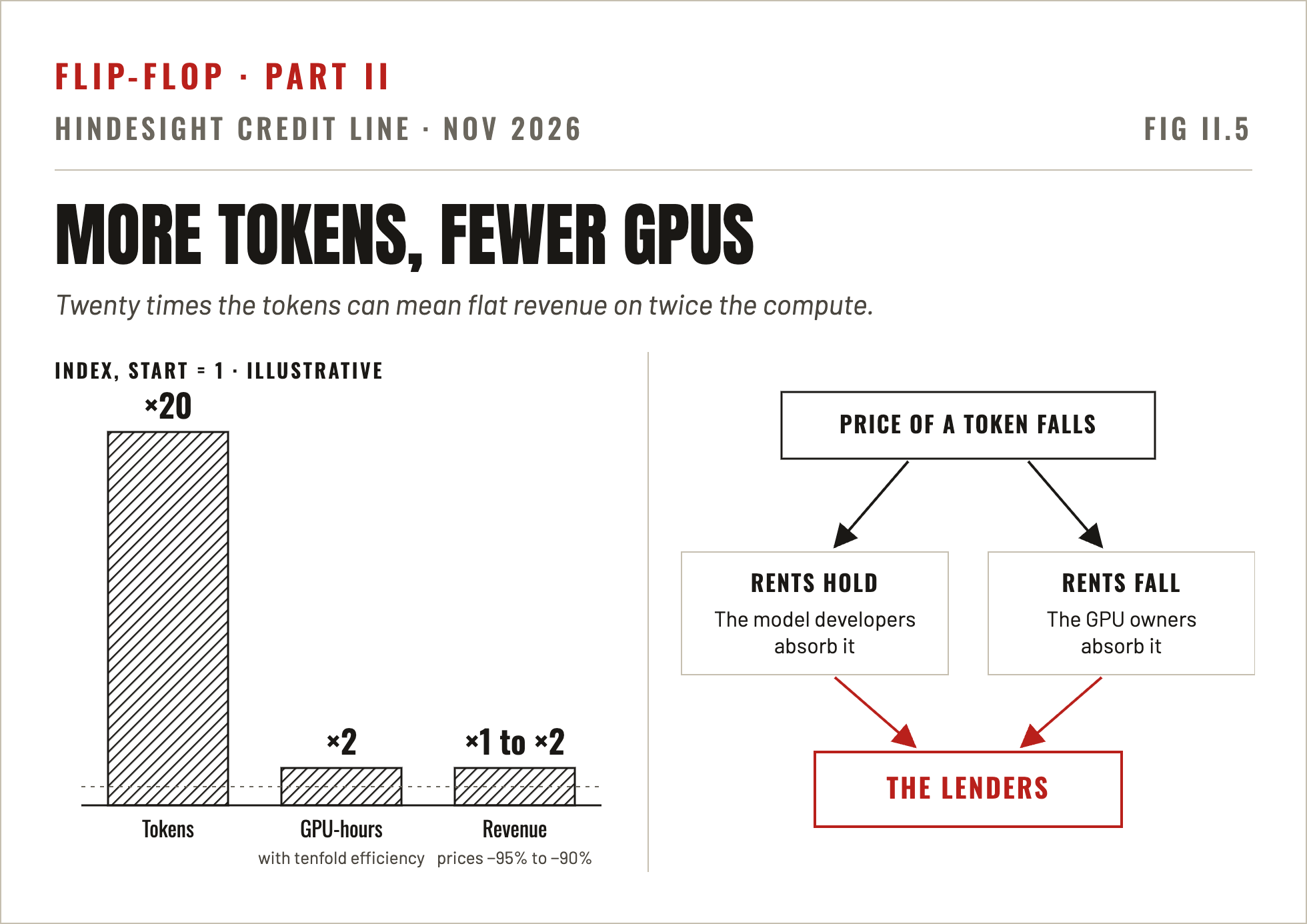
HS Chart NoteTwenty times the tokens can mean flat revenue and only twice the compute. Someone absorbs the price fall: the labs if rents hold, the GPU owners if they fall. Either way it lands with whoever borrowed against today's prices.
Open full size →Somebody has to absorb the fall in price. If GPU rents hold, the model developers absorb it, and the margin that funds their next model shrinks. If rents fall, the GPU owners absorb it, and their revenue falls below what their debt was sized on. Either way, the loss lands with whoever borrowed against today's prices.
The growth of intelligence consumed is not the growth of compute required, which is not the growth of revenue earned, which is certainly not the return on the capital invested.
Which brings us back to Anthropic's bill, and to how much of it was written at today's prices.
The Bill
Compute is bought a year or more before it is used. Anthropic says it contracts capacity 12 to 18 months ahead, that the cost is largely fixed in the near term, and, in its own words, that "in the past, we have significantly underestimated our compute requirements". It also warns that compute arriving ahead of demand could leave "committed cash outflows that do not produce immediate revenue".10 The result is a bill written at today's prices for revenue that has yet to arrive.
The filing lets us add it up. At 30 June, Anthropic had $265.6bn of fixed or minimum purchase commitments. That figure is almost exactly its three cloud contracts, at least $114.5bn with Google from April 2026 to July 2033, at least $110bn with Amazon from May 2026 to April 2036, and at least $44.9bn with Microsoft from November 2026 to May 2033. On top sat $321.4bn of leases signed but not yet started, beginning between 2026 and 2028 with terms of up to 20 years, including $161.2bn of rent on tensor processing units (TPUs) leased through Broadcom. Since June it has signed about $245bn more, and about $21bn of short-term agreements. Beyond that sits an estimated $125bn to $150bn of further TPU capacity for 2028 to 2031, not yet fixed.10
On our arithmetic, that is roughly $850bn of minimum obligations, and close to $1trn including the capacity still to be fixed. Michael Burry put it most simply. The commitments are more than twenty times trailing twelve-month sales, and about twelve times the current annual run rate.11 He is right on the numbers, though he is also an advocate, having said the market should fall far enough to stop the listing. Against that, Anthropic entered the second half with $131.7bn of cash, cash equivalents and short-term investments. That buys time. It does not establish what the commitments will earn.
Set the bill against what customers have actually promised, and the gap widens. At 30 June, Anthropic's remaining performance obligations, the revenue its customers are contractually committed to pay, stood at $10.8bn, about 75% of it due within a year. Its own minimum payments stood at $587bn, 54 times as much, before the $245bn it has signed since.10 Its customers buy as they go. Anthropic has bought for a decade.
Sources: Anthropic S-1 (third quarter implied at 86 times Q4 2024's $197m); run rate at end of July as reported by Bloomberg, 17 Aug 2026; 2028 projection, Reuters, 15 Aug 2026. Multiples are HindeSight arithmetic.
Two things keep this table honest. First, it compares a stock with a flow. The commitments run mainly to 2033 to 2036, with a tail to 2045, while revenue is earned year by year. The filing does not yet give the payments by year, and the November amendment should. Second, Anthropic's answer is growth. If revenue reaches the $190bn to $200bn it reportedly projects for 2028, the commitments fall to about four or five times a year's sales, a level many infrastructure businesses carry.12
That is the point. The bill assumes Anthropic's own plan is met, with revenue roughly tripling again to the $190bn to $200bn it has projected for 2028. Every other row of the table shows how far today's business is from that world, and the third quarter's step was shorter than the second's. The obligations are fixed. The revenue is not.
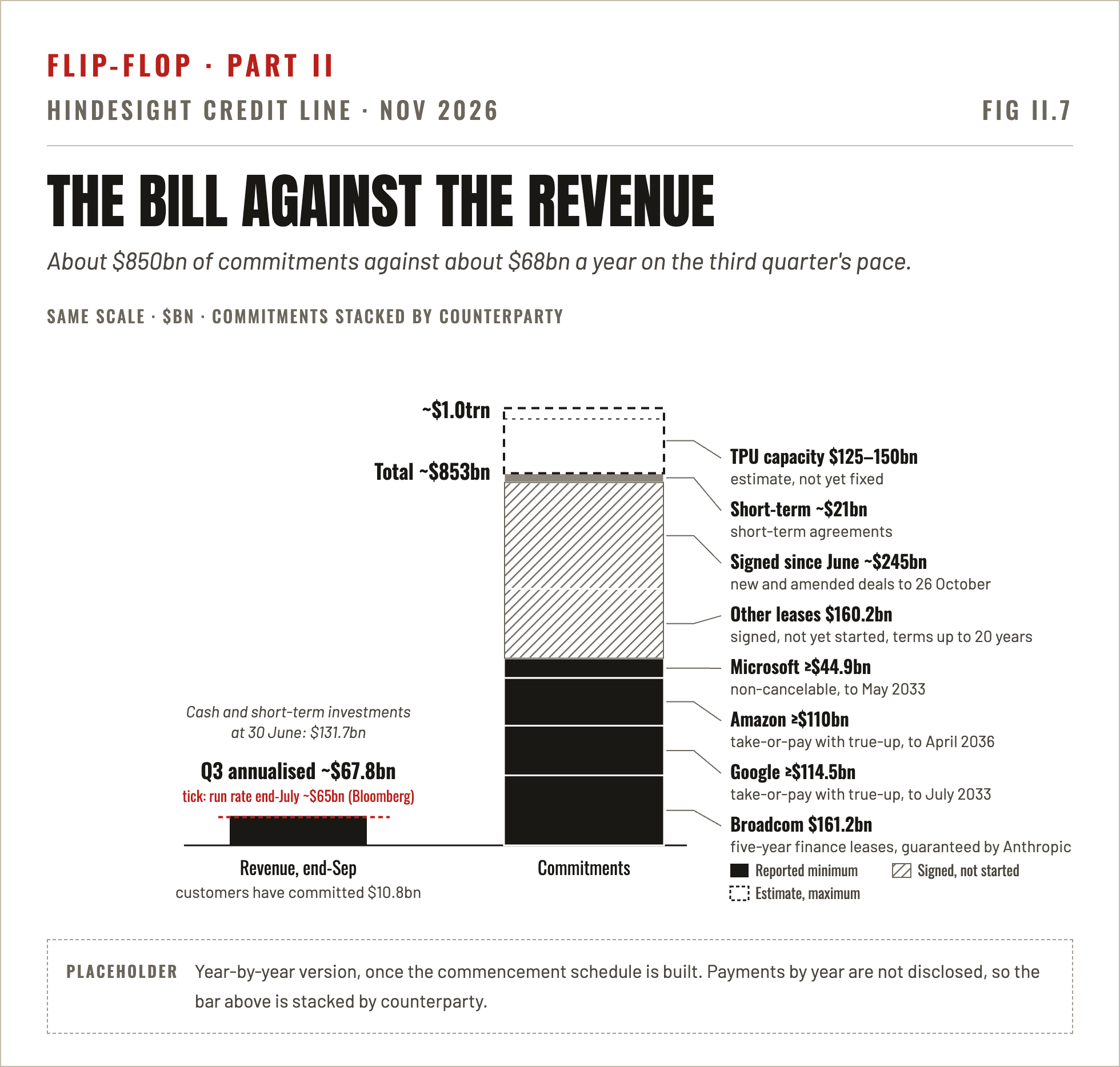
HS Chart NoteAbout $850bn of minimum commitments against a business earning about $68bn a year on the third quarter's pace, and $10.8bn that customers have actually committed. The bill assumes Anthropic's own plan is met, with revenue roughly tripling to $190–200bn by 2028. The obligations are fixed; the revenue is not.
Open full size →The bill also has a timetable. The $321.4bn of leases not yet started sit off the balance sheet today. The filing does not itemise them, but the largest piece is the Broadcom TPU leases, $161.2bn of rent, which we take apart under Hard Shells, Soft Shells below and again in Part III. On our reading, most of the rest is capacity from SpaceX's AI unit (see SpaceX Oddity), Lambda's earlier contracts and leases of data-centre space, including a 20-year lease beginning in 2027. As each begins, between now and 2028, it moves onto it, and the leverage ratios step up whatever happens to revenue. We return to that true-up in Part III.
Who signed for which part of the bill matters as much as its size. Anthropic did not sign the same kind of contract with everyone.
Hard Shells, Soft Shells
The filing puts figures on seven compute contracts worth about $637bn in all. They come in two kinds, and the split between them is the most important thing in the document for anyone lending to the build.
A customer cancelling is a demand problem; a developer unable to finance the build is a funding problem.
HS Chart NoteThe hard contracts go to the strongest counterparties, the soft ones to the neoclouds. If growth slows, the flexible layer goes first, and the neoclouds and their lenders take that loss before any hyperscaler does.
Source: Anthropic, PBC, Form S-1, 26 Oct 2026.10
The hard contracts go to the strongest counterparties. Google's and Amazon's are take-or-pay with a true-up: if Anthropic uses less than its minimum, it pays the shortfall. Microsoft's cannot be cancelled except for breach or undelivered capacity. The Broadcom leases are five-year finance leases held in two special-purpose subsidiaries, guaranteed by Anthropic, secured on the chips and cross-defaulted, with rent that can start before the data centre is ready and cash deposited as collateral. The vehicle that will buy those chips is Project North Star: $63bn of committed financing announced on 26 October, with Broadcom providing residual-value support equal to the first-lien loans, reportedly about $43.5bn.13 We take it apart in Part III.
The soft contracts go to the neoclouds. SpaceX's can be cancelled by either side at three months' notice once its initial periods end. Nscale is paid only when capacity is delivered and accepted, and must use its best efforts to raise the financing to build it. Lambda's largest contract falls away if it cannot secure the facility in time. Nscale's own prospectus shows how far it has to go: $103.4bn of contracts, only $2.6bn of them running, a first-half loss of $1.02bn, and, at filing, no binding financing commitments for the Anthropic deals.14 Lambda's backlog has risen from $15bn to $50bn in three months, mostly on Anthropic's commitment, and its listing has slipped to 2027.15
The soft side is not one thing. SpaceX's contract gives either party an option to leave. Nscale's and Lambda's otherwise bind Anthropic, but depend on the developer financing and delivering the capacity. A customer cancelling is a demand problem; a developer unable to finance the build is a funding problem. Both hurt the neocloud, but by different routes.
Not everyone grouped with the neoclouds carries the same risk. In the industry's own language, a shell is a powered building with no chips in it. Several former bitcoin miners, among them TeraWulf, Cipher and Hut 8, now lease shells to AI tenants on terms of ten to twenty years, often with a hyperscaler standing behind the rent. Hut 8's $4.25bn of Beacon Point notes, rated Baa2 and fully amortising, rest on a lease to a tenant it describes only as rated AA- or higher. Google backs about $3.2bn of Fluidstack's lease obligations at TeraWulf and about $1.4bn at Cipher, taking warrants for roughly 14% and 5.4% of the two companies; Fluidstack runs Anthropic's workloads.16 A shell landlord's risk is the tenant's rent, guaranteed by a hyperscaler. A neocloud's is the chips, their rents and its own balance sheet. The market often trades them as one group. A hard shell and a soft-boiled one look alike until they are cracked.
It is smart contracting by Anthropic, and it moves risk to the parties least able to carry it. If growth slows, the first thing Anthropic stops renewing is the flexible layer, and the neoclouds and their lenders take that loss before any hyperscaler does. Two of those contracts, worth more than $85bn between them, also depend on the neocloud raising money in exactly the market Musk says has shut. If the financing does not come, neither does the capacity, and neither does the contract.
The suppliers have also been drawn into financing the purchase. AMD's contract is non-cancelable, and AMD will buy up to $5bn of Anthropic's shares as its chips are delivered. Broadcom goes further. Alongside the leases, it stands ready to lend Anthropic up to $42bn solely to pay Broadcom's own rent, with the interest added to the loan at 9%, or 13% if Anthropic misses its revenue conditions, and repayable in shares at a discount to their market price.10 A lender whose terms get worse for the borrower precisely when the borrower's revenue disappoints has built the risk of the downturn into the contract. We will come back to it.
The tenant is sound. The risk sits with everyone who lent against its options.
Sources
- 1Hashrate Index, via Ares Management, In the Gaps, 2026. Ares, In the Gaps (PDF) ↩
- 2Ornn Compute Price Index and OpenAI Token Price Index, Bloomberg pricing, 30 Jun to 25 Oct 2026; CoreWeave closing share prices, 30 Jun to 16 Oct 2026. Ornn data ↩ a b c d e
- 3Nebius, spot-price page (preemptible prices, 30-day view), screenshot 28 Oct 2026; Nebius price page, list prices effective 1 Oct 2026; Arkady Volozh, as reported Oct 2026; Ornn, B200 index, Bloomberg pricing, 25 Oct 2026. Ornn data · Nebius spot prices ↩ a b
- 4Shanu Mathew, revenue per gigawatt, X, Oct 2026. Post ↩
- 5InferenceX margin curves, via Deedy, Oct 2026; illustrative figures are HindeSight arithmetic. Deedy post ↩
- 6Dario Amodei, Machines of Loving Grace, 2024; The Adolescence of Technology, 2026. Machines of Loving Grace · The Adolescence of Technology ↩
- 7Tarun Chitra, The Souq, Robot Ventures, 17 Aug 2026. Robot Ventures ↩
- 8SemiAnalysis, InferenceX results, Oct 2026. InferenceX ↩
- 9McKinsey capital-spending split, via Ares Management, In the Gaps, 2026. Ares, In the Gaps (PDF) ↩
- 10Anthropic, PBC, Form S-1, 26 Oct 2026. Used for: Notes 7, 13 and 17 and MD&A; compute agreements, Notes 7, 9 and 13. Form S-1 ↩ a b c d e
- 11Michael Burry, post on X, 28 Oct 2026. Post ↩
- 12Reuters, 15 Aug 2026. Reuters ↩
- 13Bank of America, Blackstone, Citi and Morgan Stanley, announcement on Broadcom investor relations, 26 Oct 2026; first-lien size via GuruFocus, citing the Wall Street Journal. Data Center Dynamics ↩
- 14Nscale, Form S-1, 18 Sep 2026. Form S-1 ↩
- 15Wall Street Journal, citing Lambda's investor letter, via TechCrunch, 6 Oct 2026. TechCrunch ↩
- 16HindeSight Below the Line Tracker (unpublished); company filings and press releases (Hut 8, 9 Jun 2026; TeraWulf, Form 8-K, 18 Aug 2025; Cipher Mining, Form 8-K, 25 Sep 2025). Blockspace on Hut 8 · TeraWulf 8-K · Cipher 8-K ↩
The small print. Worth a read.
This is not investment advice. HindeSight is one person’s attempt to make sense of the world and its markets. As a trader, I will invariably have positions that reflect some of the views expressed here, so there will be occasions when I am talking my own book. I make no apology for that, but it is something the reader should be cognisant of.
I write HindeSight as much for my own edification as anything else. The process of committing thoughts to paper forces me to test a thesis, join a few dots and occasionally discover that some of the dots had no business being joined in the first place. If, in doing so, it helps others frame their thinking or piques their curiosity, all the better.
There is no prescribed publication schedule. The letters tend to be born out of curiosity, conviction or an intellectual itch that needs scratching.
Markets are dynamic and so, by necessity, are my views. It is perfectly conceivable to be tactically bearish and thematically bullish on the same market. Equally, what seemed a compelling proposition on Monday may look rather less so by Friday. There is little virtue in remaining faithful to a thesis simply because one has committed it to paper. The art of trading, as ever, lies in marrying conviction with flexibility.
The objective is not to be proved right, but to make a return commensurate with the risk undertaken, capturing as much of the opportunity as possible whilst giving as little back as possible. Easier said than done, as most of us who have spent a lifetime in markets can attest.
Hinde Capital no longer manages external capital and there is nothing here to sell you. These letters are shared in the spirit of intellectual curiosity and the enjoyment of exchanging ideas. By all means challenge my thinking, but do your own work, take responsibility for your decisions and never take more risk than affords you a decent night’s sleep.
Nothing published here constitutes an offer, solicitation or recommendation to buy or sell any investment or financial instrument. Past performance is no guide to future returns. Readers should seek independent, regulated financial advice where appropriate. To the extent permitted by law, no liability is accepted for losses arising from reliance on this material.
By all means share the letters with your sister-in-law or brother-in-law. Whether you remain on speaking terms is, however, beyond the remit of this disclaimer.
© Hinde Capital 2026.